Psalm 133:1-3
How wonderful, how beautiful, when brothers and sisters get along!
It's like costly anointing oil
flowing down head and beard,
Flowing down Aaron's beard,
flowing down the collar of his priestly robes.
It's like the dew on Mount Hermon
flowing down the slopes of Zion.
Yes, that's where God commands the blessing,
ordains eternal life.
Proverbs 17:9
Overlook an offense and bond a friendship;
fasten on to a slight and—good-bye, friend!
From the moment we decide to become a follower of Jesus Christ, we are born into a spiritual family. Even if your name isn’t in the database, and the member box next to it is not checked off, you are still a member of the church family. There are no only children in the family of God.
Of course, that doesn’t mean that we are always one big happy family. We don’t stop being sinners the moment we begin believing in Christ. Yet, as difficult and challenging as family can be, we have a mandate to work it out. When there are breakdowns in our relationships, walking in an attitude of forgiveness makes it possible for us to repair and re-build stronger than before. When we do this, we make a powerful statement to the world.
Issues that Affect Our Willingness to Forgive
1. We want someone first to take responsibility for the harm or hurt they caused.
2. Sometimes we want someone to understand the amount of pain caused.
3. Sometimes the people to forgive are “invisible” or unknown.
4. In early stages of healing, the pain is still to great to “release” the offender.
5. Sometimes we want the offender to suffer for a while- because we have.
6. We struggle with whether offering forgiveness takes the deed too lightly- or betrays a cause or person.
Biblical Forgiveness: Presuppositions
• Retaliation does not satisfy; it multiplies injury and alienation.
• Unresolved forgiveness injures and debilitates the offended.
• Forgiveness assumes taking anger, pain and sorrow seriously.
• Forgiveness is a process, not only an act of the will (first step).
• Forgiveness is an expression of strength (not weakness).
• Processing forgiveness creates an experience of freedom
• Forgiving need not depend on acknowledgement or accountability
• Initiative in the journey of forgiveness is critical to reconciliation.
Practical Steps to Forgiveness
• Recognize that we are sinners in need of forgiveness.
• Make the choice to forgive others.
• Believe and experience Christ’s loving forgiveness in your own life.
• Ask Christ to help you overcome negative thoughts that are blocking our ability to forgive.
• Trust the Holy Spirit to empower you with the right attitude to forgive those who have hurt you.
• Trust that God will judge all the wrongs in the world.
• When struggling with forgiving others, talk with someone you respect and trust to give
Tuesday, May 18, 2010

Tuesday, March 16, 2010
The Celts and Prayer, Part 1
Throughout Scripture, festivals and feast days form a backdrop for the biblical narrative. Even today, holidays reflect the unique intersection of the sacred and the secular. When we understand the origin of these observances, it becomes possible to have meaningful conversations that can open the door to discussions about faith.
St. Patrick’s Day: A Brief History
Today is the day that commemorates the death a man named Patrick who born in the late 4th century. In many ways, Patrick is a larger than life figure. What really fascinates me about his story is that he was an ordinary person, living a fairly ordinary life. But, somewhere along the line, a seed was planted in him; and because there was good soil, it grew and multiplied. Initially, there was no way to know that this would happen. Patrick was born in Britain to wealthy parents. Historians say that there is no evidence that Patrick came from a particularly religious family.
In the meantime, Julius Caesar had withdrawn from Britain. Without the protection of being a part of the Roman Empire, Britain was vulnerable to attack. As a result, the Celts overtook the country, raided Patrick’s family estate, and took him captive. For the next six years, Patrick was a slave in Ireland, and worked as a shepherd. While tending sheep and living in danger and isolation, Patrick had a conversion experience in which he became a devout follower of Jesus Christ.
Eventually, Patrick escaped and went back to Britain. According to his writings, he heard the voice of the Lord which instructed him to return to Ireland as a missionary. Before returning to Ireland, Patrick spent fifteen years training and preparing for his life's work. After his ordination as a priest, he was sent to Ireland with a dual mission-to minister to Christians already living in Ireland and to begin to convert the Celts to Christianity.
Tuesday, March 2, 2010
Rung 1: READ
Luke 11:5-11
Then he said to them, "Suppose one of you has a friend, and he goes to him at midnight and says, 'Friend, lend me three loaves of bread, because a friend of mine on a journey has come to me, and I have nothing to set before him.' "Then the one inside answers, 'Don't bother me. The door is already locked, and my children are with me in bed. I can't get up and give you anything.'I tell you, though he will not get up and give him the bread because he is his friend, yet because of the man's boldness he will get up and give him as much as he needs.
"So I say to you: Ask and it will be given to you; seek and you will find; knock and the door will be opened to you. For everyone who asks receives; he who seeks finds; and to him who knocks, the door will be opened.
"Which of you fathers, if your son asks for a fish, will give him a snake instead? Or if he asks for an egg, will give him a scorpion? If you then, though you are evil, know how to give good gifts to your children, how much more will your Father in heaven give the Holy Spirit to those who ask him!"
Rung 2: MEDITATE
Use your imagination to enter the scene. It’s the middle of the night. Some visitors have come and you have nothing to offer them. The stores are closed. You throw on a robe, and run over to your neighbor in your pajamas and slippers. You bang on the door. Lights come on, dogs start barking. There is a commotion behind the door, but no one opens it.
• What other things do you see, hear or feel?
• What are you thinking, and what emotions are you experiencing?
• Read the passage again slowly. Repeat and ponder whatever words or phrases from your reading strike you.
Let’s take a moment to look at one of the primary images- the bread. Bread is food and life for us all. When Israel was in the dessert, God provided manna or bread from heaven. The city Bethlehem means “House of Bread” in Hebrew. Jesus said, "I am the bread of life". In Scripture, famine or lack of bread meant physical as well as spiritual death.
Rung 3: PRAY & CONTEMPLATE
This is where we listen for God’s voice within the text.
Verses 5-6
• What pressing issues in your life are represented by a lack of bread?
• Is there anyone in your life who has been on a long journey, and is looking to you for hospitality?
Verses 7-8
• What are the logical arguments, circumstances or past experiences that cause you to make excuses for why the door will not be answered?
Verses 9-10
• Jesus is speaking directly to you. What thoughts or feelings come to mind when you hear his words to you:
1. Ask!
2. Seek!
3. Knock!
Verses 11-13
• What are some good gifts that you would like to see manifest in your life?
• Do you Trust that God will give you what you need?
• Do you believe that He is the giver of good gifts?
Rung 4: DISCUSS
Rung 5: WITNESS IN THE WORLD
How is God inspiring you to take bold action for yourself due to a “ lack of bread”?
In what way is God challenging you to take bold action on behalf of others?
Lectio Divina
Chew on this.
Lectio Divina is Latin for “Divine Reading”. It is the spiritual exercise of praying or singing the Scriptures slowly and contemplatively.
Ruminate: ru•mi•nate
1. To chew the cud, as a ruminant.
2. To chew again or over and over.
3. To meditate on; ponder or muse.
While the word ruminate may not be familiar, the activity of ruminating is. It is what we do when we worry or fret over something. We re-play arguments or hurts in our mind, over and over; we imagine what we would say to the person who has wronged us; we mutter and mumble to ourselves saying, “I can’t believe she had the nerve to say that to me!” We imagine all kinds of terrible scenarios. This is ruminating in a negative way.
Instead of running this type of internal dialogue, we should recall the Apostle Paul’s encouragement to the Philippians:
Finally, brothers and sisters, whatever is true, whatever is noble, whatever is right, whatever is pure, whatever is lovely, whatever is admirable—if anything is excellent or praiseworthy—think about such things.
It Makes Me Wonder…
You may have thought that the band Led Zeppelin came up with the phrase, “Stairway to Heaven”. Actually, it was a 12th century European monk named Guigo de Castro who described Lectio Divina by this term. In his work, Guigo outlined a form of meditative pray that was analogous to the rungs of a ladder.
Rung 1: READ (Lectio)
Rung 2: MEDITATE (Meditatio)
Rung 3: PRAY (Oratio) & CONTEMPLATE (Contemplatio)
Rung 4: DISCUSS (Collatio)
Rung 5: WITNESS IN THE WORLD (Operatio)
Sunday, February 14, 2010
Fast!
STEP 5: Put Yourself on a Schedule:For maximum spiritual benefit, try to set aside ample time to be alone with the Lord. Listen for His leading. If you are married, try to begin and end each day on your knees with your spouse for a brief time of praise and thanksgiving to God. Longer periods of time with the Lord in prayer and study of His Word are often better spent alone.
Morning
• Begin your day in praise and worship.
• Read and meditate on God's Word, preferably on your knees.
• Invite the Holy Spirit to work in you. Pray for God’s vision for your life and empowerment to do His will.
• Ask God to use you. Watch and discover how you can influence, your family, your church, your work/ school, your community, etc.
Noon
• Return to prayer and God's Word.
• Take a short prayer walk.
• Intercede on behalf of your city and nation’s leaders; pray for the unreached of the world; pray for your particular needs and your family.
Evening
• Get alone for an unhurried time of "seeking His face."
• If possible, find time to meet with others who are also fasting.
• Limit the t.v. or other diversions that may hinder your spiritual focus.
Tuesday, February 9, 2010
Daniel Fast: Get Set...
STEP 3: Prepare Yourself Spiritually
Repentance is the foundation of fasting and prayer. Un-confessed sin will hinder your prayers. Here are several things you can do to prepare your heart:
• Confess all sin that the Holy Spirit calls to your remembrance, and accept God's forgiveness.
• Forgive those who have hurt you, and seek forgiveness from all whom you have offended.
• Ask God to fill you with His Holy Spirit.
• Focus on God’s attributes: His love, sovereignty, power, wisdom, faithfulness, grace, compassion, etc.
• Expect God to do something great.
• Don’t be surprised if you face obstacles or experience opposition.
STEP 4: Prepare Yourself Physically
Fasting requires reasonable precautions. Those who are elderly, under twelve, pregnant, breastfeeding, diabetic, have a history of eating disorders, have a medical condition, have a cold, the flu or some other temporary illness, or take certain medications should not fast from food. Since we are starting with a partial fast, the physical impact should be minimal; however, planning in advance will allow you to maximize your ability to pay full attention to the Lord in prayer.
• Begin limiting caffeine intake, and minimize high-fat and sugary foods. Withdrawal from caffeine and sugar may cause headaches. Physical annoyances may also include weakness, tiredness, or sleeplessness.
• You may also experience mental discomforts like impatience, crankiness and anxiety.
• Rest as much as your schedule will permit.
• Drink plenty of water. If you experience hunger pains or headaches, increase your liquid intake.
Friday, February 5, 2010
Daniel Fast- Get Ready...
In preparation for our fast 2/15-2/17, I am posting some helpful hints that will hopefully make your fast effective.
STEP 1: Set Your Objective• The first question you should ask yourself is, “Why am I fasting?” Are you fasting for spiritual renewal, for guidance, for healing, for the resolution of problems or for special grace to handle a difficult situation?
• Ask the Holy Spirit to clarify His leading and objectives for your prayer fast. This will enable you to pray more specifically and strategically.
STEP 2: Make Your Commitment• We will participate in a partial fast that is based upon the fast of the prophet Daniel (Dan.1:1-13). For 3 days, we will only eat fresh fruits, vegetables, whole grains, nuts, seeds, legumes, and water.
Other things to consider during your fast:
• What physical or social activities you will restrict?
• How much time each day you will devote to prayer and God's Word?
Making these commitments ahead of time will help you sustain your fast when physical temptations and life's pressures tempt you to abandon it.
Saturday, January 23, 2010
Prayer and Fasting
For several weeks, I have been re-exploring the discipline of fasting. Christian fasting is the voluntary denial of something for a specific time, for a spiritual purpose by an individual, family, community or nation. Traditionally this has meant food, but can include abstaining from t.v., music, technology, shopping, etc.
At various times in my life, I have fasted. On one particular occasion, I fasted from food for three days. During that time, I experienced amazing spiritual breakthroughs, clarity and a heightened awareness of God’s presence. I also had a heightened awareness of the presence of darkness/ evil. Despite those positives, I haven’t been very regular with my practice. As I have talked to other Christians, many acknowledge that they have never fasted for spiritual reasons and/or have no desire to. Why is this discipline so neglected?
In her book Fasting Spiritual Freedom Beyond Our Appetites, Linda Baab gives several reasons why fasting has lost its popularity among Western Christians. For one, consumerism is so prevalent in our culture that it encourages us to fulfill our every desire. Baab suggests that we fear deprivation and have been “subtly convinced that the indulgence of every appetite is psychologically and physically healthy” (19). Secondly, she points out that many Americans are obsessed with weight management and being thin; as a result, fasting is associated with a diet mentality rather than as a way to make room for prayer and hearing God.
Baab also discusses the gender issues related to fasting. Women, typically have more eating disorders which make fasting for spiritual reasons a struggle (If you have an eating disorder, you are not advised to fast from food). Interestingly, men are less likely to fast. Baab says that this too may also be cultural. The male identity in our society emphasizes strength, competence, power and control. Fasting from all food challenges us to let go of our strength and experience and depend on God (25).
There is a level of mystery surrounding the practice of fasting. Last Thursday, our missional community studied the following passage in Mark:
25 When Jesus saw that the people came running together, He rebuked the unclean spirit, saying to it, “Deaf and dumb spirit, I command you, come out of him and enter him no more!” 26 Then the spirit cried out, convulsed him greatly, and came out of him. And he became as one dead, so that many said, “He is dead.” 27 But Jesus took him by the hand and lifted him up, and he arose.
28 And when He had come into the house, His disciples asked Him privately, “Why could we not cast it out?”
29 So He said to them, “This kind can come out by nothing but prayer and fasting.”
I have done a fair amount of reading on fasting, but I still don’t fully understand how it works to make our prayers more effective. Nonetheless, I am developing the conviction that I need to make fasting a more regular part of my lifestyle. The reality is that my list of people with serious health conditions, financial situations, relational problems and emotional disturbances is growing. Yes, I pray; but perhaps it is time for me to take more seriously Jesus’ statement that some “kinds can come out by nothing but prayer and fasting.”[NKJ)
In preparation for Lent, I invite you to join me in 3 day Daniel Fast 2/15-2/17. More to come!
Reflection Questions
• When you consider the word fasting, what thoughts and feelings come to mind, both positive and negative?
• Consider the ways you like to be competent, feel in control and work from a position of strength. In what ways might fasting help you rely on God’s strength?
Prayer
God, help me explore the obstacles to fasting that I might face. Guide my steps to a small beginning.
Sunday, January 17, 2010
Paul's Letter to American Christians by MLK Jr.
To commemorate Martin Luther King Jr. Day, I thought I would post one of his sermons.
Paul's Letter to American Christians, November, 4, 1956:
I would like to share with you an imaginary letter from the pen of the Apostle Paul. The postmark reveals that it comes from the city of Ephesus. After opening the letter I discovered that it was written in Greek rather than English. At the top of the first page was this request: "Please read to your congregation as soon as possible, and then pass on to the other churches."
For several weeks I have worked assiduously with the translation. At times it has been difficult, but now I think I have deciphered its true meaning. May I hasten to say that if in presenting this letter the contents sound strangely Kingian instead of Paulinian, attribute it to my lack of complete objectivity rather than Paul's lack of clarity.
It is miraculous, indeed, that the Apostle Paul should be writing a letter to you and to me nearly 1900 years after his last letter appeared in the New Testament. How this is possible is something of an enigma wrapped in mystery. The important thing, however, is that I can imagine the Apostle Paul writing a letter to American Christians in 1956 A.D. And here is the letter as it stands before me.
I, an apostle of Jesus Christ by the will of God, to you who are in America, Grace be unto you, and peace from God our Father, through our Lord and Savior, Jesus Christ.
For many years I have longed to be able to come to see you. I have heard so much of you and of what you are doing. I have heard of the fascinating and astounding advances that you have made in the scientific realm. I have heard of your dashing subways and flashing airplanes. Through your scientific genius you have been able to dwarf distance and place time in chains. You have been able to carve highways through the stratosphere. So in your world you have made it possible to eat breakfast in New York City and dinner in Paris, France. I have also heard of your skyscraping buildings with their prodigious towers steeping heavenward. I have heard of your great medical advances, which have resulted in the curing of many dread plagues and diseases, and thereby prolonged your lives and made for greater security and physical well-being. All of that is marvelous. You can do so many things in your day that I could not do in the Greco-Roman world of my day. In your age you can travel distances in one day that took me three months to travel. That is wonderful. You have made tremendous strides in the area of scientific and technological development.
But America, as I look at you from afar, I wonder whether your moral and spiritual progress has been commensurate with your scientific progress. It seems to me that your moral progress lags behind your scientific progress. Your poet Thoreau used to talk about "improved means to an unimproved end." How often this is true. You have allowed the material means by which you live to outdistance the spiritual ends for which you live. You have allowed your mentality to outrun your morality. You have allowed your civilization to outdistance your culture. Through your scientific genius you have made of the world a neighborhood, but through your moral and spiritual genius you have failed to make of it a brotherhood. So America, I would urge you to keep your moral advances abreast with your scientific advances.
I am impelled to write you concerning the responsibilities laid upon you to live as Christians in the midst of an unChristian world. That is what I had to do. That is what every Christian has to do. But I understand that there are many Christians in America who give their ultimate allegiance to man-made systems and customs. They are afraid to be different. Their great concern is to be accepted socially. They live by some such principle as this: "everybody is doing it, so it must be alright." For so many of you Morality is merely group consensus. In your modern sociological lingo, the mores are accepted as the right ways. You have unconsciously come to believe that right is discovered by taking a sort of Gallup poll of the majority opinion. How many are giving their ultimate allegiance to this way.
But American Christians, I must say to you as I said to the Roman Christians years ago, "Be not conformed to this world, but be ye transformed by the renewing of your mind." Or, as I said to the Phillipian Christians, "Ye are a colony of heaven." This means that although you live in the colony of time, your ultimate allegiance is to the empire of eternity. You have a dual citizenry. You live both in time and eternity; both in heaven and earth. Therefore, your ultimate allegiance is not to the government, not to the state, not to nation, not to any man-made institution. The Christian owes his ultimate allegiance to God, and if any earthly institution conflicts with God's will it is your Christian duty to take a stand against it. You must never allow the transitory evanescent demands of man-made institutions to take precedence over the eternal demands of the Almighty God.
I understand that you have an economic system in America known as Capitalism. Through this economic system you have been able to do wonders. You have become the richest nation in the world, and you have built up the greatest system of production that history has ever known. All of this is marvelous. But Americans, there is the danger that you will misuse your Capitalism. I still contend that money can be the root of all evil. It can cause one to live a life of gross materialism. I am afraid that many among you are more concerned about making a living than making a life. You are prone to judge the success of your profession by the index of your salary and the size of the wheel base on your automobile, rather than the quality of your service to humanity.
The misuse of Capitalism can also lead to tragic exploitation. This has so often happened in your nation. They tell me that one tenth of one percent of the population controls more than forty percent of the wealth. Oh America, how often have you taken necessities from the masses to give luxuries to the classes. If you are to be a truly Christian nation you must solve this problem. You cannot solve the problem by turning to communism, for communism is based on an ethical relativism and a metaphysical materialism that no Christian can accept. You can work within the framework of democracy to bring about a better distribution of wealth. You can use your powerful economic resources to wipe poverty from the face of the earth. God never intended for one group of people to live in superfluous inordinate wealth, while others live in abject deadening poverty. God intends for all of his children to have the basic necessities of life, and he has left in this universe "enough and to spare" for that purpose. So I call upon you to bridge the gulf between abject poverty and superfluous wealth.
I would that I could be with you in person, so that I could say to you face to face what I am forced to say to you in writing. Oh, how I long to share your fellowship.
Let me rush on to say something about the church. Americans, I must remind you, as I have said to so many others, that the church is the Body of Christ. So when the church is true to its nature it knows neither division nor disunity. But I am disturbed about what you are doing to the Body of Christ. They tell me that in America you have within Protestantism more than two hundred and fifty six denominations. The tragedy is not so much that you have such a multiplicity of denominations, but that most of them are warring against each other with a claim to absolute truth. This narrow sectarianism is destroying the unity of the Body of Christ. You must come to see that God is neither a Baptist nor a Methodist; He is neither a Presbyterian nor a Episcopalian. God is bigger than all of our denominations. If you are to be true witnesses for Christ, you must come to see that America.
But I must not stop with a criticism of Protestantism. I am disturbed about Roman Catholicism. This church stands before the world with its pomp and power, insisting that it possesses the only truth. It incorporates an arrogance that becomes a dangerous spiritual arrogance. It stands with its noble Pope who somehow rises to the miraculous heights of infallibility when he speaks ex cathedra. But I am disturbed about a person or an institution that claims infallibility in this world. I am disturbed about any church that refuses to cooperate with other churches under the pretense that it is the only true church. I must emphasize the fact that God is not a Roman Catholic, and that the boundless sweep of his revelation cannot be limited to the Vatican. Roman Catholicism must do a great deal to mend its ways.
There is another thing that disturbs me to no end about the American church. You have a white church and you have a Negro church. You have allowed segregation to creep into the doors of the church. How can such a division exist in the true Body of Christ? You must face the tragic fact that when you stand at 11:00 on Sunday morning to sing "All Hail the Power of Jesus Name" and "Dear Lord and Father of all Mankind," you stand in the most segregated hour of Christian America. They tell me that there is more integration in the entertaining world and other secular agencies than there is in the Christian church. How appalling that is.
I understand that there are Christians among you who try to justify segregation on the basis of the Bible. They argue that the Negro is inferior by nature because of Noah's curse upon the children of Ham. Oh my friends, this is blasphemy. This is against everything that the Christian religion stands for. I must say to you as I have said to so many Christians before, that in Christ "there is neither Jew nor Gentile, there is neither bond nor free, there is neither male nor female, for we are all one in Christ Jesus." Moreover, I must reiterate the words that I uttered on Mars Hill: "God that made the world and all things therein . . . hath made of one blood all nations of men for to dwell on all the face of the earth."
So Americans I must urge you to get rid of every aspect of segregation. The broad universalism standing at the center of the gospel makes both the theory and practice of segregation morally unjustifiable. Segregation is a blatant denial of the unity which we all have in Christ. It substitutes an "I-it" relationship for the "I-thou" relationship. The segregator relegates the segregated to the status of a thing rather than elevate him to the status of a person. The underlying philosophy of Christianity is diametrically opposed to the underlying philosophy of segregation, and all the dialectics of the logicians cannot make them lie down together.
I praise your Supreme Court for rendering a great decision just two or three years ago. I am happy to know that so many persons of goodwill have accepted the decision as a great moral victory. But I understand that there are some brothers among you who have risen up in open defiance. I hear that their legislative halls ring loud with such words as "nullification" and "interposition." They have lost the true meaning of democracy and Christianity. So I would urge each of you to plead patiently with your brothers, and tell them that this isn't the way. With understanding goodwill, you are obligated to seek to change their attitudes. Let them know that in standing against integration, they are not only standing against the noble precepts of your democracy, but also against the eternal edicts of God himself. Yes America, there is still the need for an Amos to cry out to the nation: "Let judgement roll down as waters, and righteousness as a mighty stream."
May I say just a word to those of you who are struggling against this evil. Always be sure that you struggle with Christian methods and Christian weapons. Never succumb to the temptation of becoming bitter. As you press on for justice, be sure to move with dignity and discipline, using only the weapon of love. Let no man pull you so low as to hate him. Always avoid violence. If you succumb to the temptation of using violence in your struggle, unborn generations will be the recipients of a long and desolate night of bitterness, and your chief legacy to the future will be an endless reign of meaningless chaos.
In your struggle for justice, let your oppressor know that you are not attempting to defeat or humiliate him, or even to pay him back for injustices that he has heaped upon you. Let him know that you are merely seeking justice for him as well as yourself. Let him know that the festering sore of segregation debilitates the white man as well as the Negro. With this attitude you will be able to keep your struggle on high Christian standards.
Many persons will realize the urgency of seeking to eradicate the evil of segregation. There will be many Negroes who will devote their lives to the cause of freedom. There will be many white persons of goodwill and strong moral sensitivity who will dare to take a stand for justice. Honesty impels me to admit that such a stand will require willingness to suffer and sacrifice. So don't despair if you are condemned and persecuted for righteousness' sake. Whenever you take a stand for truth and justice, you are liable to scorn. Often you will be called an impractical idealist or a dangerous radical. Sometimes it might mean going to jail. If such is the case you must honorably grace the jail with your presence. It might even mean physical death. But if physical death is the price that some must pay to free their children from a permanent life of psychological death, then nothing could be more Christian. Don't worry about persecution America; you are going to have that if you stand up for a great principle. I can say this with some authority, because my life was a continual round of persecutions. After my conversion I was rejected by the disciples at Jerusalem. Later I was tried for heresy at Jerusalem. I was jailed at Philippi, beaten at Thessalonica, mobbed at Ephesus, and depressed at Athens. And yet I am still going. I came away from each of these experiences more persuaded than ever before that "neither death nor life, nor angels, nor principalities, nor things present, nor things to come . . . shall separate us from the love of God, which is in Christ Jesus our Lord." I still believe that standing up for the truth of God is the greatest thing in the world. This is the end of life. The end of life is not to be happy. The end of life is not to achieve pleasure and avoid pain. The end of life is to do the will of God, come what may.
I must bring my writing to a close now. Timothy is waiting to deliver this letter, and I must take leave for another church. But just before leaving, I must say to you, as I said to the church at Corinth, that I still believe that love is the most durable power in the world. Over the centuries men have sought to discover the highest good. This has been the chief quest of ethical philosophy. This was one of the big questions of Greek philosophy. The Epicurean and the Stoics sought to answer it; Plato and Aristotle sought to answer it. What is the summon bonum of life? I think I have an answer America. I think I have discovered the highest good. It is love. This principle stands at the center of the cosmos. As John says, "God is love." He who loves is a participant in the being of God. He who hates does not know God.
So American Christians, you may master the intricacies of the English language. You may possess all of the eloquence of articulate speech. But even if you "speak with the tongues of man and angels, and have not love, you are become as sounding brass, or a tinkling cymbal
Tuesday, January 12, 2010
Thoughtfully Available
Change, whether good or bad, can bring about feelings of fear, loss, discouragement and anxiety. Pastoral care involves practical ways of ministering to the needs of people particularly in times of transition or crisis. It is the expression of God’s love as experienced in the reality in relationships.
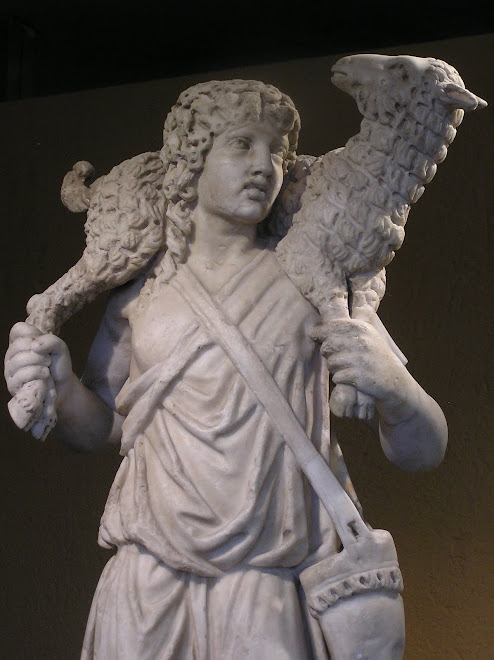
When I think about pastoral care, the image of the shepherd is what comes to mind. Jesus Christ is our Good Shepherd. He protects, encourages, restores, guides and comforts. Each of us is called to be a shepherd; but, in order to do this effectively, we must be thoughtfully available. Thoughtful availability is a broader way of thinking about hospitality. It requires focus and attentiveness. It means actively listening and watching so that we pick up on the subtle cues that reveal what is happening in others’ lives.
My constant prayer is that I would have the discipline to be thoughtfully available on a consistent basis.
• What does it mean to you to say that “The LORD is my shepherd”?
• Why does our culture seem to struggle with being thoughtfully available? What can we do to overcome this tendency?
Subscribe to:
Posts (Atom)

 Posts